Prince William CANCELS Camilla’s State Visit…
Prince William CANCELS Camilla’s State Visit Plans — Assigns All Duties to Duchess Catherine
The Silent Shift: A New Chapter for the British Monarchy
The British monarchy is a fortress of tradition, built upon centuries of rigid protocol, unspoken rules, and the heavy weight of history. For decades, the rhythm of life within Buckingham Palace was steady and predictable. But even the sturdiest walls eventually feel the pressure of a changing world. Recently, a series of quiet, deliberate movements behind the scenes has suggested that the House of Windsor is undergoing a profound transformation. This is not a story of a revolution fought with weapons or public outbursts; rather, it is a story of a subtle, calculated evolution led by the heir to the throne, Prince William, and the woman who stands beside him, Catherine, Princess of Wales.
The Bold Correction: When the Heir Said “No”
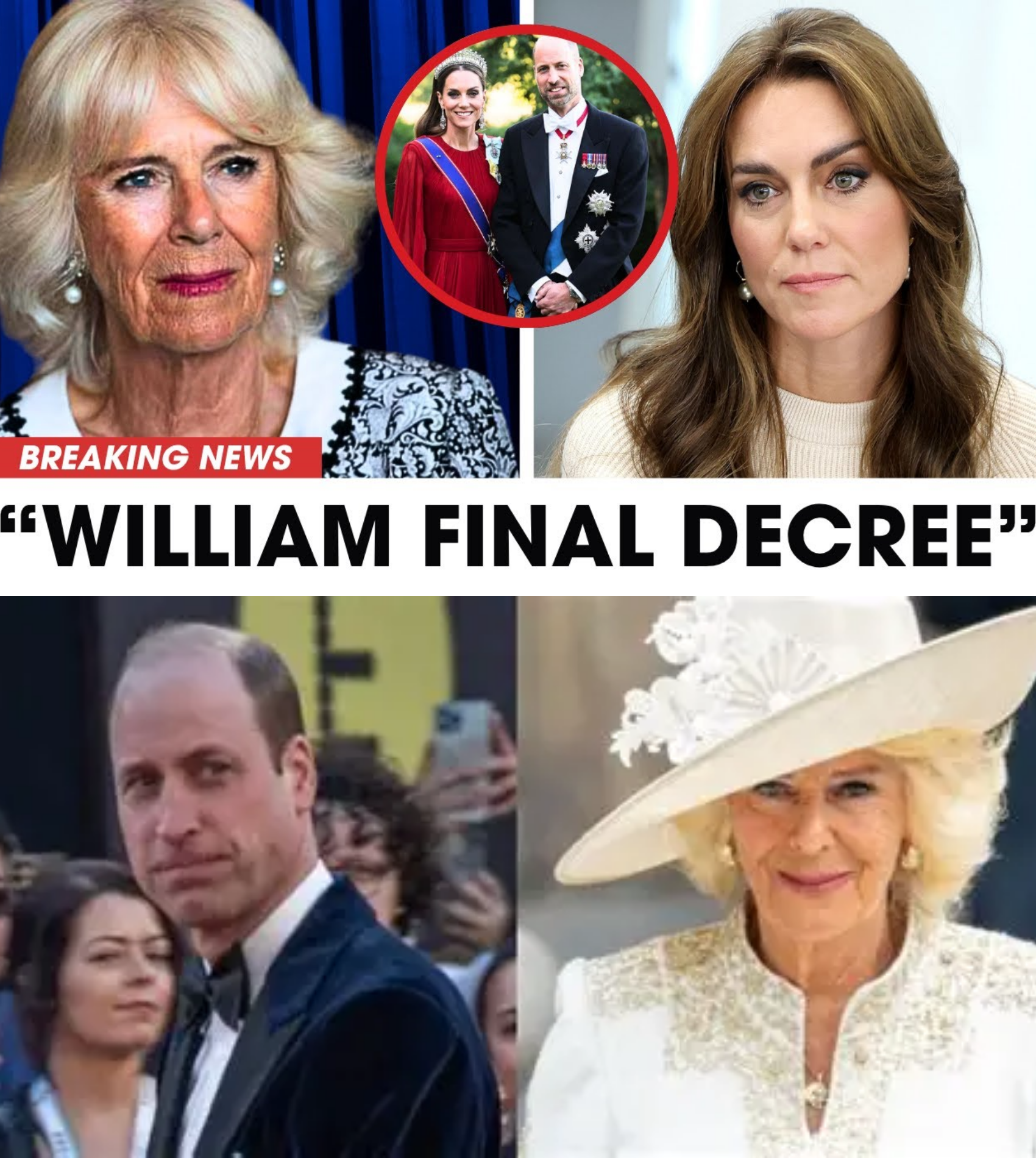
The first tremors of this change were felt when reports emerged that Prince William had taken the unprecedented step of canceling a state visit planned by Queen Camilla. To the outside world, the palace cited “scheduling conflicts,” a phrase as cold and emotionless as stone. But those familiar with the inner workings of the royal household knew better. This was not a logistical mishap; it was a clear, unambiguous act of defiance. For the first time in living memory, the heir to the throne had overruled the Queen Consort, effectively asserting a new level of authority.
The news sent shockwaves through royal circles. While the old guard—those fiercely loyal to the traditional hierarchy—bristled with indignation, a different feeling rippled through the younger courtiers. It was a sense of exhilaration. For years, the palace had been a place where truth often bowed to tradition, and image frequently replaced sincerity. By taking this stand, Prince William signaled that the monarchy could no longer afford to be a static relic. His advisers viewed the move not as a rebellion, but as a “correction,” a necessary step toward modernizing an institution that had risked losing its connection to the people it serves.
A Vision for the Future: Change with Purpose
Prince William has always been known for his restraint, but his recent remarks have revealed a man deeply committed to a new kind of leadership. During an informal and refreshingly candid conversation with actor Eugene Levy, the Prince spoke openly about his agenda. When asked what kind of king he envisions being, William did not retreat into the rehearsed, vague platitudes of the past. Instead, he spoke with a steady, quiet conviction: “Change is on my agenda.”




He clarified that he does not seek to tear down the foundations of the monarchy, but rather to evolve it. He wants to maintain what is good while discarding the outdated rituals that no longer serve a purpose. His vision is not grounded in grand, ego-driven gestures, but in relevance, empathy, and transparency. To the establishment, these words were unsettling, but to the public, they felt like a breath of fresh air. It is the voice of a man who understands that the survival of the crown depends not on the majesty of its history, but on its ability to listen, adapt, and remain human.
The Quiet Rise of the Princess of Wales
As the dynamics within the palace continue to shift, all eyes have turned toward Catherine, the Princess of Wales. While the media often searches for scandal, they have found in Catherine something far more compelling: a presence that is both comforting and commanding. Her power does not roar; it radiates. In a world that is often loud and chaotic, her poise and sincerity have become a source of stability.
When she steps into a room, there is no need for grand proclamations. Her empathy for the people she meets—whether she is comforting a grieving family or kneeling to speak with children—has redefined what it means to be a royal. While others have fought for their place in the palace through survival and calculated diplomacy, Catherine has simply become the center of the monarchy through grace alone. Her influence has moved through the corridors of power like a gentle fragrance—subtle, yet impossible to ignore. It is as if the crown itself, in its wisdom, has found its new focus, quietly transitioning from the era of the Queen Consort to the era of the Princess who will one day reign.
A Reborn Monarchy: Compassion Over Prestige
The transformation is perhaps most visible in how the palace conducts its daily business. Invitations that once favored titled aristocrats and political elites are now extended to teachers, nurses, and local community leaders. The focus of royal events has shifted from prestige to presence. This evolution is happening without fanfare, but the impact is undeniable. Courtiers who once operated under the old regime are now instinctively aligning themselves with the calm, sincere authority that William and Catherine represent.
King Charles has watched this unfolding process with a mixture of relief and deep reflection. He recognizes that his son and daughter-in-law are building a future that transcends the rigid boundaries of the past. Their partnership is a harmony of heart and purpose, a living pulse that cannot be manufactured by any public relations strategy.
The Dawn of a New Era
As spring returns to London, the atmosphere inside Buckingham Palace feels fundamentally different. The hollow laughter and rehearsed smiles of the past have been replaced by a genuine warmth. The public has noticed, and their devotion has grown accordingly. They no longer gather just to witness the spectacle of royalty; they come because they believe in the people who represent the crown.
The journey toward this new dawn has been quiet, deliberate, and entirely necessary. The monarchy is not being destroyed; it is being reborn. By embracing change with conviction rather than fear, Prince William and Catherine are ensuring that the crown remains relevant for generations to come. They have proven that true power does not need to be demanded—it only needs to be lived. And as they stand on the balcony, looking out over a changing world, it is clear that the future of the British monarchy is in steady, compassionate hands. The shadows of the past are fading, and in their place, a new light is beginning to shine.