Catherine Steals The Spotlight In Radiant Red Dress As William Can’t Take His Eyes Off Her
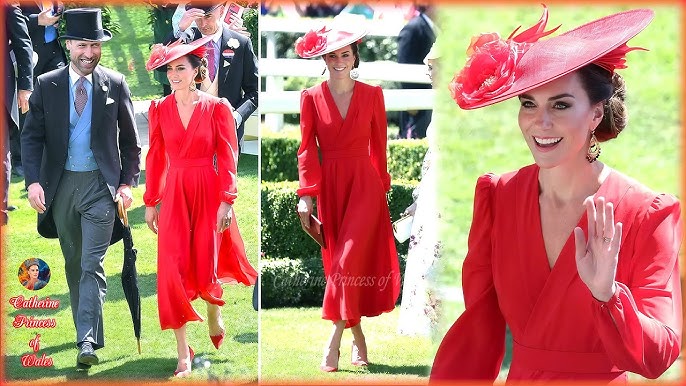
Catherine, Princess of Wales, has long been admired for her ability to transform every appearance into a carefully balanced moment of elegance, symbolism, and modern relevance. Her latest outing in a crimson Alexander McQueen gown paired with a Philip Treacy hat was no exception. The look, instantly hailed as one of her most commanding to date, carried all the hallmarks of her enduring style philosophy: regal refinement, contemporary boldness, and subtle storytelling through fashion.
A Masterclass in Power Dressing
The gown itself was striking. Crafted with structured shoulders, a refined neckline, and a flowing A-line silhouette, it struck the perfect balance between sharp tailoring and romantic movement. The choice of deep red was deliberate—a color long associated with passion, strength, and authority. In an era where Catherine’s public role grows ever more central, the ensemble read as a sartorial declaration: she is a woman fully at ease in her position, both as Princess of Wales and as a modern royal navigating global scrutiny.
The addition of a sculptural Philip Treacy hat elevated the look into one of high pageantry. Treacy’s designs are renowned for their dramatic elegance, and here, the piece framed Catherine’s face like a crown, underscoring her status while complementing rather than overwhelming the ensemble. Accessories—an Hermès clutch, red suede heels, and her trusted Sézane gold earrings—were subtle reminders of her penchant for pairing high-end luxury with understated, repeatable favorites.
The Symbolism of Red
The choice of red was more than aesthetic. In royal fashion history, crimson has often appeared at pivotal moments: coronations, jubilees, and state ceremonies. It carries a visual weight that commands attention without need for words. For Catherine, who often employs her wardrobe as a form of nonverbal communication, the color reflected a blend of strength in duty and warmth in personal character. It also provided a striking parallel to her 2011 wedding gown, another Alexander McQueen creation that continues to resonate as a symbol of new beginnings and enduring influence. While the wedding dress marked her entry into royal life, this latest gown reflected her maturity and authority as a leading figure in the monarchy.




William’s Unmistakable Admiration
Observers noted that the true magic of the moment was not in Catherine’s attire alone, but in Prince William’s reaction. Usually the epitome of composure, William seemed visibly captivated, his subtle glances and smiles betraying a quiet but palpable pride. This dynamic added an intimate layer to the occasion: the poised future queen consort on display for the world, and the admiring husband whose affection was evident in every frame. The couple’s chemistry reminded many why they continue to represent stability, romance, and continuity within the royal family.
A Family in Focus
Their joint public appearance was swiftly followed by a more intimate family moment: a return to the cherished Crathie Kirk Church near Balmoral. Steeped in royal tradition, the church is closely tied to the memory of Queen Elizabeth II, making the outing both symbolic and sentimental.
Prince William, now 42, drove the family in a Range Rover, exuding the quiet steadiness that defines his public persona. Beside him sat Catherine, her elegance softened by the warmth of motherhood. In the back were their three children: Prince George, 12, Princess Charlotte, 10, and Prince Louis, 7. Their coordinated outfits and relaxed presence underscored the Waleses’ deliberate effort to project unity and continuity—a family rooted in tradition but visibly close-knit.
Also present were King Charles III, 76, and Queen Camilla, 77, who arrived separately in understated style. Their attendance reinforced the strength of the monarchy as a family institution, even as it adapts to new leadership and the challenges of modern expectations.
A Narrative of Continuity and Strength
Together, these appearances painted a portrait of the Waleses as both symbolic leaders and relatable figures. Catherine’s fashion served as a powerful statement of confidence, modern femininity, and royal gravitas, while William’s visible admiration provided a rare glimpse of vulnerability and affection from a man often defined by duty. Their children’s presence at Balmoral highlighted the continuity of tradition, grounding the monarchy in its generational story.
In the broader arc of Catherine’s public life, the red McQueen gown will be remembered as more than a glamorous fashion moment. It was a milestone—one that reflected her evolution from royal bride to confident, central figure of the monarchy, admired as much for her symbolism as for her beauty. In tandem with William’s steady devotion, it signaled not only the enduring strength of their partnership but also the monarchy’s ability to project resilience, unity, and modern relevance in a rapidly changing world.