Catherine and Meghan ‘Step Out’ Wearing Diana’s Priceless Jewelry Collection
Diana’s jewelry collection has never been mere ornament—it has always been a language of memory, legacy, and identity. Today, that legacy is divided between two women who embody strikingly different paths within and beyond royal life. Catherine, the Princess of Wales, carries the pieces that root her firmly in tradition, cementing her role as the natural heir to Diana’s place in the monarchy. Meghan, the Duchess of Sussex, holds pieces that echo Diana’s independence, her post-divorce freedom, and the defiance that defined her final years. Together, their choices reveal that Diana’s story is still being told—through diamonds, sapphires, pearls, and aquamarines—long after her death.
The most famous of all is Catherine’s 12-carat sapphire and diamond Garrard engagement ring, the same ring Prince William placed on her finger in 2010. Originally chosen by Diana in 1981 from Garrard’s catalog, the ring was once seen as unconventional—a modern bride selecting a non-bespoke jewel. In Catherine’s hands, however, it became a symbol of continuity and reverence, binding her not just to Diana’s memory but also to the Windsor lineage. From the very moment of her engagement, Catherine was positioned as custodian of Diana’s most enduring legacy.
That symbolism has only deepened as Catherine inherited more of Diana’s royal jewels. The Lover’s Knot Tiara, one of Diana’s favorite pieces, has become Catherine’s hallmark at state banquets and formal portraits. Its rows of diamonds and dangling pearls frame her as the image of regal tradition, reinforcing her role as future queen consort. Equally poignant are the pearl drop earrings, once worn by Diana during her marriage, and the Prince of Wales feather brooch, originally crafted with diamonds and an emerald cabochon. Each appearance signals Catherine’s role as Diana’s spiritual successor within the monarchy.
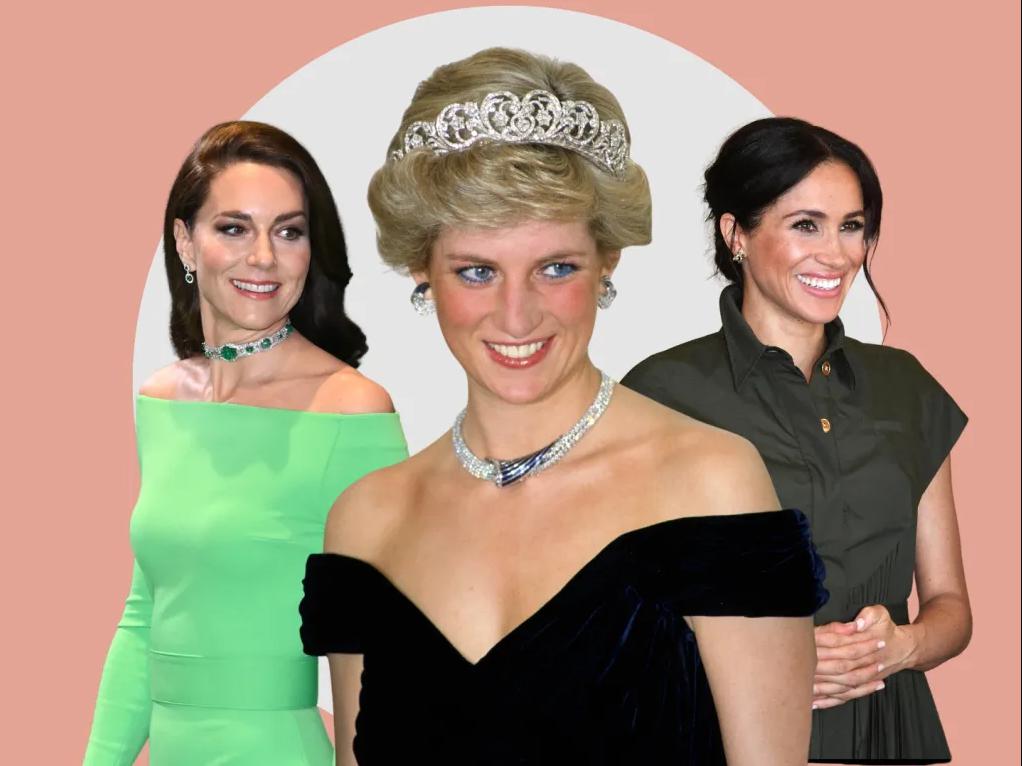
Beyond the classics, Catherine has also worn the lavish Saudi sapphire suite, gifted to Diana on her wedding in 1981 by Crown Prince Fahd. The suite—a necklace, earrings, and bracelet—was among Diana’s boldest jewelry sets, pieces she wore in the 1980s when the world saw her as both princess and global icon. When Catherine dons these sapphires, it is more than a nod to Diana’s glamour; it is an acknowledgment that she now carries the full weight of royal heritage, standing in for Diana in both ceremonial grandeur and national symbolism.




Meghan’s jewels, however, tell a different story—one that celebrates Diana’s independence and post-palace reinvention. She has worn Diana’s Cartier Tank Française watch, the yellow gold timepiece Diana often sported in the 1990s as she crafted a new life after her divorce. Meghan first showcased the watch during her Time 100 portrait with Harry in 2020, the ticking gold face on her wrist serving as a deliberate message: she too was building a new identity beyond the palace walls.
Meghan also treasures the Cartier diamond tennis bracelet, another of Diana’s 1990s staples. She has worn it on red carpets and public appearances, pairing it with her own jewelry in a way that blends past and present. It is not framed in royal tradition, but instead integrated into the style of a woman forging her own path. Most striking of all is Diana’s aquamarine cocktail ring, a bold, rectangular stone set in white gold, which Diana wore following her divorce as a symbol of independence. Meghan debuted it at her 2018 wedding reception with Harry, its icy blue brilliance glowing against her modern Stella McCartney gown. In that moment, Meghan embodied Diana’s spirit of liberation, declaring that her story too would be one of freedom beyond the crown.
The division of these jewels traces back to a poignant moment in 1997. After Diana’s death, her sons were allowed to choose keepsakes from her collection. William selected the Cartier watch, while Harry chose the sapphire engagement ring. Years later, the brothers exchanged these heirlooms: William asked for the sapphire to give to Catherine, recognizing its symbolic weight, while Harry took the watch that would later pass to Meghan. Harry would later write in his memoir that he felt peace in the exchange, knowing that the ring belonged with William’s future wife. This private decision became a moment of royal folklore, a reminder that even glittering objects can carry immense emotional weight.
The contrast between Catherine and Meghan’s jewelry choices underscores their distinct roles. Catherine dons Diana’s tiara at state banquets, appearing in portraits that situate her within centuries of royal pageantry. Her jewelry becomes a visual anchor for tradition, offering reassurance that the monarchy continues with stability and grace. Meghan, meanwhile, uses Diana’s pieces as personal emblems of identity. The Cartier watch gleams in photographs of her life in California. The aquamarine ring surfaces in moments that emphasize independence and reinvention. These appearances project a Diana who lived beyond palace gates, who dared to craft a self-defined life.
Observers often note that Catherine’s jewels symbolize continuity, while Meghan’s symbolize reinvention. When Catherine wears the Lover’s Knot Tiara, the public sees heritage, order, and the promise of a future queen. When Meghan wears Diana’s watch or bracelet, the message is freedom, activism, and individuality. Each woman draws from Diana, but each channels her in a way that reflects their own path.
Ultimately, Diana’s jewels do more than sparkle—they speak. They remind us that Diana was not one story but many: the young princess, the queen-in-waiting, the fashion icon, the activist, and the independent woman who sought life on her own terms. Catherine carries Diana’s royal legacy, ensuring the jewels remain part of the monarchy’s fabric. Meghan carries Diana’s independent legacy, reminding the world of her strength and defiance. Together, these jewels weave a dual narrative of duty and freedom.
More than two decades after her death, Diana’s jewelry remains alive—circulating not just as adornments but as symbols of power, identity, and memory. Every time they reappear—whether in the candlelit halls of Buckingham Palace or on a California red carpet—they continue Diana’s story, proving that her legacy endures not in one woman, but in the contrasting paths of two.