Princess Charlotte’s Adorable Curtsy to King Charles Steals Spotlight at Coronation Concert
The coronation concert for King Charles III was a dazzling spectacle—an evening of fireworks, world-class performances, and carefully orchestrated pageantry. Over 20,000 people filled the grounds, and more than 10 million watched from home, but it was not just the music that caught the world’s attention. Instead, one of the most poignant moments belonged to 8-year-old Princess Charlotte, whose small but significant gesture reminded everyone that royal tradition is carried forward not only by crowns and ceremonies, but also by the children growing up within its shadow.
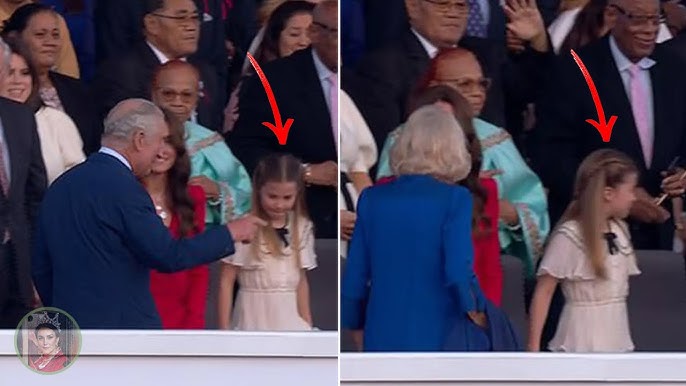
As the newly crowned King and Queen entered the royal box to thunderous applause, Charlotte rose alongside her siblings to greet them. With a look of earnest concentration, she dipped into a neat curtsy for her grandfather, an act of formality that carried both sweetness and weight. Yet in her eagerness to face the king, Charlotte inadvertently turned away just as Queen Camilla stepped forward, missing the chance to extend the same courtesy to her step-grandmother. For a brief moment, the air seemed to pause—protocol unfulfilled, eyes watching. But Camilla, at 77 and seasoned in navigating public scrutiny, responded with grace. She rested a gentle hand on Charlotte’s shoulder, smiled warmly, and offered a soft greeting that dissolved any awkwardness. It was a fleeting but telling exchange: formality met with kindness, and tradition softened by humanity.
Charlotte’s curtsy at the coronation was far from an isolated gesture. In fact, curtsying has become something of a motif in her young royal life. Her very first public attempt came in July 2017, at Warsaw’s Chopin Airport in Poland. Just two years old and clad in a red dress with matching shoes, Charlotte was preparing to board a plane to Berlin during a royal tour. With a little nudge from her mother, Princess Catherine, she bent her knees in an adorably wobbly curtsy to the dignitaries awaiting the family. Though simple, it was her first step into the centuries-old choreography of monarchy.
By Christmas Day 2019, Charlotte’s confidence had grown. Walking with her family to the traditional Sandringham church service, the then 4-year-old paused to curtsy to her great-grandmother, Queen Elizabeth II, as the late monarch departed. The sight of a small child executing such a gesture of respect melted hearts across Britain. What struck observers was not just the cuteness of the act, but its symbolic weight: a fourth generation already embracing the rituals of royal life.




Perhaps the most moving curtsy of Charlotte’s young life came during the state funeral of Queen Elizabeth II in September 2022. At only 7 years old, standing before the eyes of the world, she lowered herself in solemn respect as her great-grandmother’s coffin passed. It was no longer just a sweet gesture of tradition, but an expression of grief, reverence, and maturity far beyond her years. That curtsy became one of the defining images of the funeral, proof that Charlotte, even as a child, understood the gravity of duty and loss.
These moments are more than childhood curiosities; they mark Charlotte’s growing role in the monarchy. Born in 2015, she became the first British princess to outrank a younger brother in succession thanks to the 2013 reforms ending male preference. Now third in line to the throne, after her father William and brother George, she is expected to one day inherit the title of Princess Royal, following in the footsteps of her great-aunt, Princess Anne. With such a position comes responsibility, and every public gesture—no matter how small—acquires symbolic resonance.
What makes Charlotte’s story compelling is the blend of innocence and heritage she embodies. Each curtsy is at once a child’s act of obedience and a future queen’s rehearsal for the responsibilities that lie ahead. The coronation moment, with its tiny slip and Camilla’s forgiving smile, underscored the balance at the heart of the monarchy: precision and humanity, tradition and adaptation.
As the years pass, Charlotte will continue to refine these gestures, moving from sweet curtsies to the poised dignity expected of a senior royal. But for now, she remains a child—dutiful, spirited, and occasionally imperfect. And it is in those imperfections that the public finds its greatest affection. For every precise bow and every missed moment, Charlotte reminds the world that the monarchy is not just an institution, but a family, and its future rests in the hands of children still learning, still growing, and still curtsying their way into history.