The “Kate Effect” Strikes Again! Catherine’s Stunning Mughal Dress Creates Global Fashion Craze
[Music] Princess Catherine, the Princess of Wales, has long been celebrated for her ability to blend diplomacy and elegance with striking authenticity—and her appearance in a Mughal-inspired ensemble by renowned Indian designer Anita Dongre remains one of the defining examples of her cross-cultural fashion diplomacy. On the first day of her royal tour of India with Prince William, Catherine stepped out into the sun-dappled gardens of Mumbai wearing a flowing printed tunic dress that instantly captivated both the global media and local admirers.
The dress, drawn from Dongre’s Spring/Summer “Love Notes” collection, featured delicate Mughal motifs intricately block-printed across soft, airy fabric in shades of azure, coral, and ivory. The silhouette—feminine yet relaxed—reflected both the designer’s signature aesthetic and Catherine’s modern, approachable sensibility. As the warm coastal breeze of Mumbai rippled through the hem of her tunic, the effect was mesmerizing. Every movement spoke of lightness and poise, turning what could have been a simple daytime engagement into an unforgettable fashion moment.
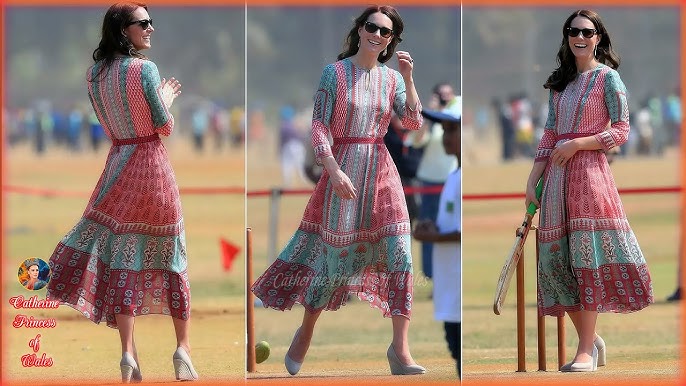
Catherine paired the tunic dress with mint green wedge espadrilles by Mint Velvet, a brand she has worn on several casual occasions, and accessorized with filigree bead drop earrings from Accessorize. Her chestnut hair was styled in soft, loose waves, while minimal makeup allowed her natural glow to shine through. It was a carefully considered look—comfortable enough for outdoor activities, but refined enough to command royal stature.
The princess and Prince William began the day by meeting local artisans and youth groups before heading to a cricket pitch for a lighthearted match with children. Catherine, in her printed dress, joined in the fun, laughing as she swung a cricket bat—proof that style and substance can coexist seamlessly. Despite the heat and the physicality of the moment, she appeared effortless, engaging with everyone she met with genuine warmth and joy.




The significance of Catherine’s wardrobe choice extended far beyond aesthetics. Wearing an Indian designer was a subtle but deeply meaningful gesture—one that honored the country’s rich textile traditions and acknowledged its thriving modern fashion scene. In doing so, Catherine demonstrated a sophisticated awareness of the power of clothing as a tool for cultural diplomacy. Her decision to champion local design reinforced her reputation as a royal who uses fashion not as mere adornment, but as a bridge between people and cultures.
Designer Anita Dongre herself later shared that the moment had an extraordinary and immediate impact. Within hours of Catherine’s public appearance, Dongre’s official website experienced an unprecedented surge in traffic—so much so that it crashed temporarily under the weight of global demand. “It was overwhelming,” Dongre told reporters. “We had women from around the world asking for the same dress. It was surreal.” The “Kate effect,” as it’s now famously known, once again proved its power to transform a single fashion moment into a worldwide phenomenon.
The dress sold out within hours, and Dongre’s label gained global recognition overnight. Yet for Catherine, the decision had been entirely organic. Her long-standing commitment to sustainable, meaningful fashion—favoring designs that tell a story, highlight craftsmanship, and celebrate local artisans—aligned perfectly with Dongre’s ethos. The designer, known for her focus on ethical production and traditional Indian embroidery, found in Catherine an ambassador who embodied her values of femininity, cultural appreciation, and timeless grace.
Even years later, Dongre continues to receive requests for “the Catherine dress.” “That one moment changed everything,” she reflected. “It reminded people that Indian fashion can be both traditional and contemporary, and Catherine showcased that beautifully.”
The global press mirrored this sentiment. Vogue India described the ensemble as “a masterclass in cultural sensitivity and effortless glamour.” Harper’s Bazaar UK called it “the perfect expression of modern monarchy—refined, thoughtful, and deeply human.” Indeed, the look transcended trends and became an enduring symbol of how fashion, in Catherine’s hands, can carry meaning far beyond the surface.
At her side, Prince William complemented her with understated polish in a navy suit and crisp white shirt, his relaxed demeanor mirroring Catherine’s warmth. The couple’s body language throughout the day—smiling, laughing, interacting comfortably with locals—captured the very essence of their modern royal image: approachable, genuine, and globally aware.
Their time in India was filled with moments that reflected compassion and connection. From visiting child welfare charities to meeting conservationists and artists, the royal pair demonstrated an engagement that was heartfelt rather than ceremonial. Catherine’s choice of attire on that first day set the tone for the entire tour—one grounded in respect, inclusion, and authenticity.
For royal watchers and fashion enthusiasts alike, the image of Catherine in Anita Dongre’s Mughal-inspired dress endures as one of her most iconic style moments. It encapsulates everything that defines her influence: an unwavering sense of grace, a deep understanding of cultural nuance, and the rare ability to make diplomacy feel personal.
In the years since that visit, the dress has become more than a piece of fashion history—it has become a symbol of how empathy can be woven into elegance, and how a simple garment can convey a world of meaning. Whether standing on palace steps or laughing with children halfway across the globe, Princess Catherine continues to redefine royal style—not as spectacle, but as a language of unity, humility, and timeless beauty.