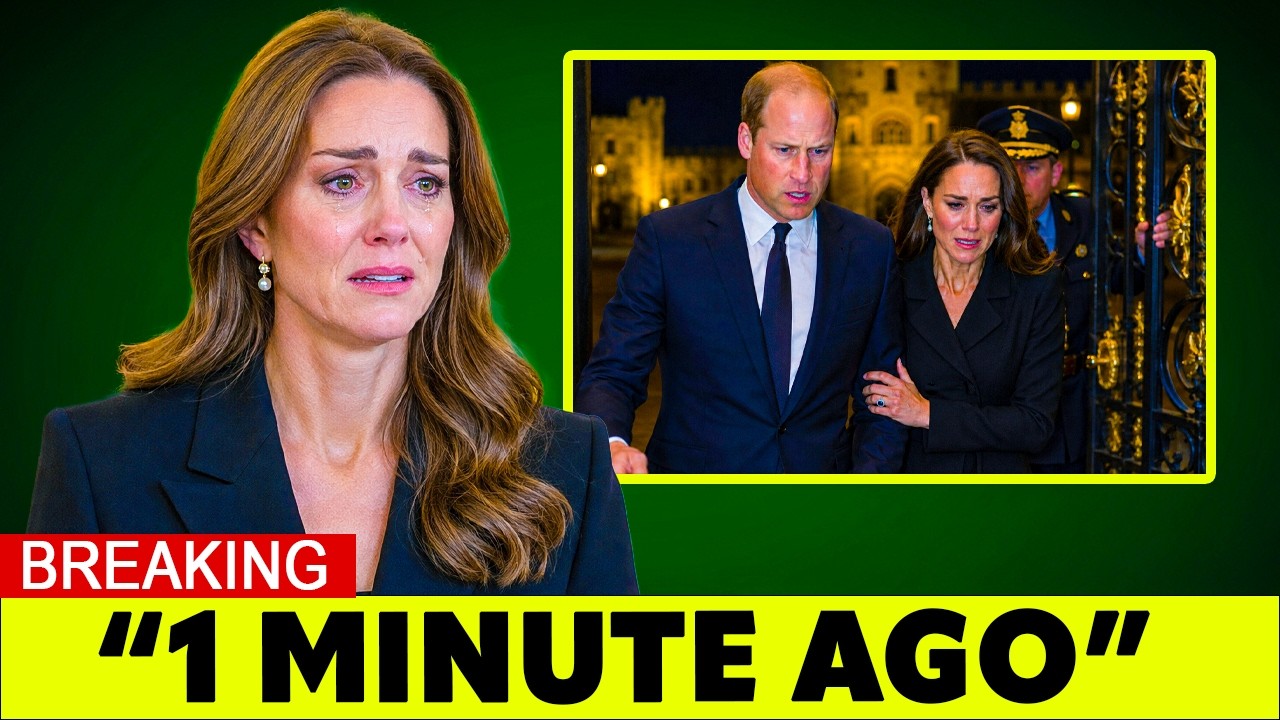
1 MIN AGO: William & Catherine MAKE Surprise Visit to Windsor After Tragic News About Louis
There was no grand announcement from Buckingham Palace, no carefully prepared briefing, no official explanation designed to calm the public before speculation could begin. Instead, there was only a quiet appearance at Windsor, a sudden movement inside the royal calendar that seemed ordinary at first glance but quickly became impossible for palace watchers to ignore.
Prince William and Catherine, Princess of Wales, were seen moving through the moment with a mood that did not resemble routine royal duty. They did not appear like two senior royals performing another carefully staged obligation. To many observers, they looked more like parents carrying something private, something heavy, something that belonged not to the institution but to the family behind it.
Within hours, public curiosity turned into a wave of concern.
What had pulled them into silence so suddenly?



Why Windsor?
Why now?
And why had the palace chosen not to explain?
Royal schedules are rarely spontaneous. Every public movement is usually planned with precision. Every appearance passes through layers of coordination, security review, media management, and internal messaging. Even small adjustments tend to be handled with care because, inside the monarchy, a schedule is never just a schedule. It is a signal.
That is why this particular visit immediately drew attention. There was no major engagement attached to it. No obvious ceremonial duty. No public statement explaining its purpose. Just a sudden shift, a quiet presence, and a silence that grew louder with every passing hour.
For a family watched as closely as the Windsors, silence rarely remains empty. It becomes a space into which the public pours questions, worries, theories, and emotions. That is exactly what happened here.
At first, commentators tried to frame the moment through the usual royal language. Was this a private family gathering? Was it a routine visit? Was it connected to a scheduling adjustment too minor for public explanation? But the more people studied the situation, the less it felt like ordinary royal business.
There was no sense of ceremony around the appearance. No visible attempt to project confidence. No carefully polished message of institutional stability. Instead, the atmosphere seemed guarded, restrained, and deeply personal. Observers described a different kind of energy around William and Catherine, less formal and less calculated than usual.
That was enough to set the royal world talking.
The public has learned, over time, to read royal appearances like coded messages. A delayed arrival can become a headline. A shortened engagement can ignite days of speculation. A carefully chosen location can be interpreted as a symbol. A single expression can be studied, frozen, enlarged, and debated.
This is the strange reality of modern royal life. The family speaks rarely, but everything they do is interpreted. Their silence is treated as language. Their movements are treated as clues. Their absences sometimes matter more than their appearances.
And Windsor, of all places, carries its own emotional weight.
It is not merely a royal residence. It is a symbol of continuity, retreat, family history, and private reflection. For generations, Windsor has stood somewhere between public monarchy and private refuge. It is close enough to the heart of royal life to reassure the nation, yet protected enough to become a place where the family can retreat when public ceremony is no longer the priority.
That history made the visit feel heavier.
When royals disappear into Windsor unexpectedly, people notice. They remember earlier moments when official schedules changed and private realities took over. They remember times when palace language became cautious, appearances became fewer, and the family seemed to move inward rather than outward.
That does not mean every quiet visit signals crisis. But it does explain why this moment became so powerful.
What made the appearance different was not simply where William and Catherine went. It was how little was said afterward.
Normally, even private royal moments are wrapped in enough context to slow speculation before it becomes uncontrollable. A brief note. A soft explanation. A carefully worded palace line. Something to place the event safely inside the public narrative.
This time, there was no rush to explain.
That absence created a vacuum. And in public life, vacuums rarely stay empty.
Online discussions multiplied quickly. Some observers insisted there was nothing unusual at all and warned against turning a private family moment into a public drama. Others argued that royal schedules do not change without reason and that the lack of explanation was itself unusual. Still others focused not on the schedule, but on William and Catherine’s demeanor.
That is when the conversation changed.
People stopped asking what the royals were doing.
They started asking whether they were all right.
Once that shift happens, every detail begins to feel significant. Posture. Timing. Facial expression. The closeness between husband and wife. The decision to appear at all. The decision not to say more.
Some observers suggested William seemed especially protective, quieter and more inward than expected. He has long built a public image around steadiness and control, so even the slightest change in his manner can attract attention. He is not known for dramatic emotional displays. That means subtle differences can appear larger than they might for someone else.
Catherine drew similar attention. Some said she seemed particularly attentive to those around her, more focused on the immediate circle than on the broader public expectations attached to royal appearances. Again, none of this confirmed anything. No official statement supported any dramatic conclusion. But the speculation continued because, once emotion enters the picture, observation quickly turns into meaning.
That is the difficult line in modern royal coverage.
A thoughtful expression is not evidence.
A quiet visit is not proof of hidden news.
Concern is not confirmation.
Yet public emotion does not always wait for facts. When answers do not arrive, people begin assembling stories from fragments. A pause becomes a clue. A location becomes a symbol. A silence becomes an announcement without words.
This is not unique to William and Catherine, but it is especially intense around them because they represent more than two senior royals. They represent the future of the monarchy. They are parents of the next generation. They are public figures, national symbols, and private human beings all at once. That combination creates endless fascination and almost impossible pressure.
The Windsor appearance seemed to bring all of those tensions together.
On one level, it was a simple question of privacy. A family had gone somewhere quietly, and the palace had chosen not to reveal the full reason. In ordinary life, that would barely be noticed. Families gather. Plans change. People deal with private matters privately.
But the monarchy does not exist in ordinary life.
Every royal decision takes place inside the tension between public duty and private need. The public feels emotionally connected to the family. People celebrate their milestones, worry during difficult periods, and invest in their image of stability. That connection is part of the monarchy’s enduring power.
But emotional connection also creates expectation.
The public wants reassurance. The public wants information. The public wants to understand what is happening, especially when the people involved are central to the nation’s future.
William and Catherine have spent years trying to balance that pressure. They are public enough to fulfill duty, but private enough to protect family life. They have often appeared determined to give their children something closer to normality than previous generations of royal children received. That effort has shaped how they approach visibility, especially during moments that involve health, family, and emotional strain.
Perhaps that is why the Windsor visit resonated so deeply. It did not look like a political statement. It did not feel like a formal royal performance. It felt, to many watching, like a family closing ranks.
And that possibility changed the tone of the entire story.
Suddenly, this was no longer just about schedules. It was about values. It was about how a future king and queen might define leadership not only through speeches, ceremonies, and public duties, but through the decision to protect what belongs inside the family.
That is a very different kind of royal message.
For decades, monarchy has been associated with visibility. Show up. Stand firm. Reassure the nation. Continue the ceremony. Keep the image intact. The institution survives by projecting continuity even when private life is difficult.
But William and Catherine appear to be shaping a slightly different model. Not one that rejects duty, but one that insists family life cannot be sacrificed entirely to public expectation. Their approach suggests that leadership may sometimes mean refusing to explain everything, especially when explanation would turn a private moment into a public possession.
That choice carries risks.
Silence can look mysterious. Privacy can look suspicious. Restraint can be misread as concealment. The less the palace says, the more people speculate. The more people speculate, the harder it becomes to restore calm.
But overexplaining carries risks too. If every private matter requires a public statement, the boundary between royal duty and family life disappears. The family becomes not simply visible, but exposed. And exposure, once normalized, is almost impossible to reverse.
That is the dilemma at the center of this Windsor story.
The public wanted to know more. William and Catherine appeared to offer only presence.
No dramatic declaration. No emotional statement. No invitation into whatever conversations may have been happening behind closed doors. Just a quiet appearance, careful movement, and the sense of a family choosing to remain together under pressure.
For some, that was frustrating. For others, it was reassuring.
Because presence can have its own language.
Sometimes showing up says more than explaining. In moments of uncertainty, absence becomes a headline. Disappearance creates alarm. But continued presence, even without answers, can communicate steadiness. It can tell the public that life continues, responsibilities continue, and the family remains united even when not everything is being shared.
That may be the most important reason this moment stayed in people’s minds. Not because anyone learned exactly what happened, but because the appearance seemed to offer just enough reassurance without surrendering private space.
Windsor became part of that message.
It no longer felt merely like a retreat from public life. It began to feel like a protected space where family and duty could exist side by side. A place where William and Catherine could remain visible enough to prevent panic, but guarded enough to preserve whatever needed to remain private.
That balance is difficult to achieve, especially in the modern media environment. News moves instantly. Social media turns uncertainty into momentum. A single unexplained moment can generate thousands of interpretations before the palace has even decided whether it wants to respond.
And yet the response from Kensington Palace and the wider royal system seemed to be restraint.
That restraint may reveal something about how William and Catherine intend to lead. Their future monarchy may be more open in some areas, but more protective in others. It may offer warmth and relatability without granting unlimited access. It may modernize communication while still defending the family’s right to privacy.
That is not an easy path.
The public often says it wants authenticity, but authenticity cannot survive if every emotional moment is immediately explained, packaged, and consumed. Families need room to breathe. Children need room to grow. Parents need room to make decisions without turning every private concern into a national conversation.
William understands this perhaps more deeply than most. He grew up under the relentless pressure of public fascination. He watched his mother, Diana, Princess of Wales, become both adored and hunted by the same attention. He knows how public affection can become invasive, how concern can become entitlement, and how privacy can vanish before a person realizes it is gone.
Catherine, too, has lived through the full force of modern scrutiny. Her health, her appearances, her clothes, her expressions, and her family role have all been analyzed in painful detail. Her return to public life after serious health challenges has only deepened public interest and emotional investment. That makes the protection of private boundaries not merely a preference, but a necessity.
Seen through that lens, the Windsor appearance becomes less mysterious and more understandable.
Maybe it was not about hiding something.
Maybe it was about refusing to turn a family moment into public property.
That does not mean the public was wrong to care. The emotional connection people feel toward William and Catherine is real. Their future matters to the monarchy, and the monarchy remains a public institution. Interest in their well-being is natural.
But interest does not erase boundaries.
That is the uncomfortable truth this moment exposed. The public was invited into part of the story, not all of it. People saw enough to feel concern, but not enough to know. They saw presence, but not explanation. They saw a family moving through something quiet, but not the private reason behind it.
In an age that expects instant access, that can feel unsatisfying. Modern audiences are used to immediate answers. Silence has become suspicious. Privacy is often interpreted as strategy. Restraint can feel like withholding.
But families do not always move at the speed of public curiosity.
Sometimes they move at the speed of trust.
That may be what lingered beneath everything surrounding Windsor. Not secrecy. Not necessarily crisis. Not hidden drama waiting to explode. But an intentional decision to let some things remain within the family, at least for a time.
That is not weakness. It may be the very foundation of the kind of leadership William and Catherine are trying to build.
Because leadership is not always about giving the public more. Sometimes it is about knowing what must be protected. Sometimes it is about standing calmly inside a decision while questions continue outside. Sometimes it is about choosing presence over performance.
The Windsor silence reminded people that behind every institution are relationships. Behind every royal title are human beings. Behind every public duty are private choices that cannot always be explained without losing something essential.
Whatever brought William and Catherine to Windsor that day, the image that remained was not one of chaos. It was not one of public collapse. It was the image of a family drawing closer, quietly managing a moment that belonged more to them than to the world watching.
Royal history remembers announcements, ceremonies, speeches, and turning points. Families remember something different. They remember who showed up. They remember who stood close. They remember who protected the silence when words would have made things harder.
And perhaps that is why this moment mattered.
Not because it revealed everything.
But because it quietly revealed what mattered most.