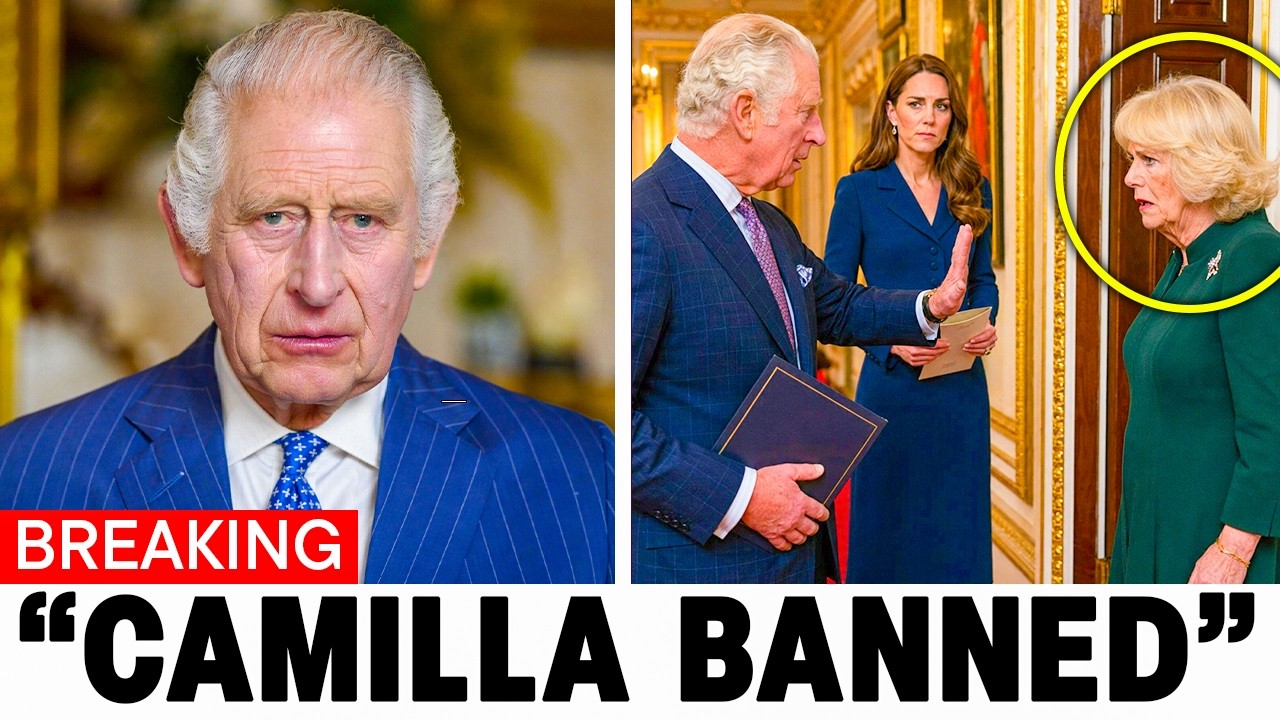
3 MIN AGO: King Charles Bans Camilla From Balmoral Private Wings After Catherine Finding
A dramatic new wave of palace speculation has erupted around Balmoral Castle after claims surfaced that King Charles ordered Queen Camilla restricted from certain private wings of the Scottish estate following concerns reportedly raised by Princess Catherine.
According to accounts circulating among royal observers, the situation began quietly. A door inside Balmoral that Queen Camilla had used for years was suddenly no longer open to her. By sunrise, whispers had already begun moving through the estate that access permissions had been changed, staff movements had been tightened, and senior aides were quietly reviewing who had been allowed near the King during one of the most vulnerable chapters of his reign.
At first, the palace allegedly attempted to frame the matter as a minor internal adjustment — a reshuffling of rooms, schedules, and household routines. But behind Balmoral’s stone walls, the issue reportedly carried far deeper meaning. This was not simply about where Camilla could walk. It was about who controlled access to King Charles while he continued facing serious health concerns.
Princess Catherine is said to have uncovered unusual access arrangements while reviewing confidential contingency documents connected to the King’s medical situation. Those documents reportedly revealed that certain people linked to Camilla’s private social circle had gained unexpected familiarity with parts of Balmoral traditionally reserved for the closest members of the royal family.




To outsiders, that may sound like palace gossip. Inside the monarchy, it is far more serious.
Balmoral has never been treated as an ordinary royal residence. It is the emotional sanctuary of the Crown, the place where Queen Elizabeth II spent her happiest private moments and where she died in September 2022. Purchased by Prince Albert for Queen Victoria in 1852, the estate became a symbol of royal retreat, family continuity, and sacred privacy.
For Queen Elizabeth, Balmoral was almost untouchable. Access was controlled carefully. Staff discipline was strict. Invitations carried meaning. Even senior royals understood there were invisible boundaries inside the estate that could not be crossed without deep trust.
That is why Catherine’s reported discovery caused such alarm.
According to palace insiders, the Princess of Wales became concerned that Balmoral’s traditional protections had softened over time. Certain informal approvals allegedly allowed people within Camilla’s wider orbit to move closer to the King’s private environment than old protocols would normally allow.
The issue became more urgent because of Charles’s health.
During a stable reign, access arrangements may seem administrative. During illness, access becomes power. Whoever controls the rooms, the schedules, the paperwork, and the emotional atmosphere around the monarch can influence decisions, relationships, and the future direction of the household.
Prince William was reportedly informed almost immediately. Sources describe him as cold, focused, and deeply concerned. His reaction was not emotional spectacle but institutional calculation. If Balmoral’s internal boundaries had weakened, he wanted them restored before confusion became precedent.
Within hours, staff schedules were allegedly changed. Security permissions were reviewed. Certain corridors became more restricted. Conversations that once occurred casually in drawing rooms were moved behind closed doors.
That sudden tightening reportedly created a sense of silent panic inside Balmoral.
Queen Camilla was later said to have left the estate earlier than expected. No official explanation was given. No palace statement addressed the rumors. But royal correspondents began noticing subtle shifts in public schedules and household movements. Something, many felt, had changed.
The deeper meaning of the crisis lies in Balmoral itself.
For the House of Windsor, Balmoral is more than land. It is royal memory. It represents continuity between generations. It is where the monarchy escapes London, reconnects with its oldest traditions, and preserves the illusion of family unity when the public world becomes too loud.
Catherine reportedly sees Balmoral as a protective sanctuary for Prince George, Princess Charlotte, and Prince Louis. Like Queen Elizabeth, she appears to understand that the monarchy survives not only through law and ceremony, but through carefully protected emotional spaces.
If Balmoral becomes vulnerable to factional influence, the future heirs lose one of the last truly secure places left in royal life.
That, according to insiders, is why Catherine acted.
She was not merely defending rooms or guest lists. She was defending the emotional architecture of the monarchy. To Catherine, Balmoral represented discipline, duty, and stability — the very qualities Queen Elizabeth spent 70 years protecting.
William reportedly shared that view. After his grandmother’s death, he increasingly saw Balmoral as a bridge between the monarchy’s past and its future. Any attempt to alter the estate’s traditions too casually would therefore be seen not as modernization, but as a threat to continuity.
This is where Queen Camilla’s position becomes delicate.
Since Charles became King, Camilla has naturally gained influence over household arrangements, social rhythms, and private royal life. As Queen, she has her own staff, her own friends, her own charitable network, and her own way of operating. Some aides reportedly viewed her changes as harmless modernization. Others saw them as the slow expansion of a new faction inside spaces once governed by Elizabeth’s old rules.
The rumored “Parker Bowles faction,” as some royal watchers call it, became a source of concern because of what it symbolized: the possibility that Camilla’s private world was moving closer to the monarchy’s most guarded inner spaces.
For William and Catherine, that was reportedly unacceptable.
Their response was described as surgical. No public fight. No humiliation. No dramatic confrontation. Instead, permissions were suspended, access reviewed, and boundaries quietly tightened. In royal life, this kind of silence can be more powerful than any public statement.
A door closes. An invitation is delayed. A familiar routine changes. A staff member shifts allegiance. Slowly, the institution signals where power is moving.
According to insiders, that power is increasingly moving toward William and Catherine.
Charles remains King, but his illness has forced the palace to think more urgently about the next reign. During periods of uncertainty, royal households historically begin consolidating around the future sovereign. Courtiers watch carefully. Staff calculate quietly. Old loyalties resurface. Future authority begins to matter more than present preference.
That process now appears to be unfolding around the Prince and Princess of Wales.
Catherine’s role has reportedly grown stronger because she is viewed as calm, disciplined, and emotionally steady. She does not appear to seek power through confrontation. Instead, she gains trust through consistency. That makes her especially valuable in a monarchy facing illness, family division, and public unease.
Many insiders now compare her style to Queen Elizabeth’s: restrained, careful, and deeply aware that personal feelings must never overwhelm institutional duty.
That comparison matters enormously.
Queen Elizabeth still shapes the monarchy even after death. Her values remain embedded in staff habits, household expectations, and the emotional meaning of places like Balmoral. If Catherine is seen as the person most capable of preserving that legacy, her influence naturally expands.
Camilla, by contrast, faces a more fragile reality. Her power is tied to Charles’s reign. She is Queen because he is King. But when the Crown passes to William, the center of royal life will shift immediately to the new monarch and Queen Catherine.
That looming transition casts a long shadow over every palace movement.
If Camilla’s access to Balmoral has indeed been restricted, the symbolism is devastating. Private wings are not just rooms. They represent trust, proximity, and acceptance inside the monarchy’s most sacred family space. Losing unrestricted access suggests a deeper withdrawal of institutional warmth.
That does not mean Camilla has been publicly disgraced. Royal power rarely collapses so loudly. More often, it fades through distance. Fewer invitations. Shorter conversations. Reduced access. Quiet changes in staff behavior.
Insiders reportedly describe this as “social freezing” — a palace phenomenon in which a person remains formally respected but slowly loses the invisible currents of loyalty that make influence real.
The emotional strain on King Charles is said to be severe. He is reportedly caught between devotion to Camilla and duty to the institution. He wants peace. But the monarchy, especially during illness, has limited patience for ambiguity.
If senior figures believe Balmoral’s boundaries were weakened, Charles may have little choice but to allow corrective action.
That is the brutal truth of monarchy. It survives by choosing the Crown over personal comfort.
The current situation also exposes the increasing authority of William. He has not yet inherited the throne, but the institution is already beginning to orient itself around him. His concern is not only his father’s health. It is the long-term stability of the monarchy his children will inherit.
That includes protecting Prince George, who will one day be King, as well as Charlotte and Louis, whose lives will be shaped by the pressures surrounding the Crown.
For William, Balmoral is not merely nostalgic. It is strategic. It is where the future royal children can experience continuity without the chaos that has haunted other branches of the family. If informal influence networks take root there, that sanctuary becomes compromised.
This is why the Balmoral crisis has become a symbol of something much larger.
It represents the conflict between personal loyalty and institutional preservation. Camilla’s supporters may see the restrictions as unfair or unnecessary. William and Catherine’s supporters may see them as essential. Charles may see both sides. But the institution itself tends to choose survival.
Throughout royal history, figures who once seemed protected have found themselves isolated when the monarchy sensed danger. The Crown is sentimental in public but ruthless in private. Affection matters, but continuity matters more.
That may be the lesson Queen Camilla is now facing.
She has spent decades moving from outsider to Queen. Her public rehabilitation was one of the most remarkable transformations in modern royal life. But rehabilitation does not equal permanent control. Her influence remains conditional, and Balmoral may have revealed the limits of that influence.
For Catherine, however, the crisis may have strengthened her position dramatically.
By reportedly identifying the access concerns and pushing for internal correction, she positioned herself as a guardian of the monarchy’s emotional and institutional boundaries. She did not need to speak publicly. She did not need to attack anyone. Her power came from acting in alignment with the Crown’s oldest instinct: protect the future.
That is why palace insiders increasingly view her not only as a future queen, but as a stabilizing force during the transition already beginning beneath the surface.
The monarchy still presents unity to the world. Public appearances remain polished. Speeches remain controlled. Smiles still appear at ceremonies. But behind those images, the House of Windsor is reportedly entering one of its most delicate internal phases since the final years of Queen Elizabeth II.
Charles’s illness has accelerated questions that might otherwise have remained distant. Who controls access? Who protects the heirs? Who preserves Elizabeth’s traditions? Who shapes the next reign before it officially begins?
The Balmoral dispute forced those questions into the open.
The palace has not publicly confirmed the alleged restrictions. It has not explained Camilla’s reported early departure. It has not addressed Catherine’s alleged review of access arrangements. That silence may be strategic, but it also fuels speculation.
In royal life, silence is rarely empty. It often signals that the truth is too sensitive to touch.
For now, Balmoral appears to have become the stage for a quiet correction. Camilla’s circle has reportedly been pushed back. William and Catherine’s authority has grown. Elizabeth’s old rules have resurfaced. Staff loyalties are shifting toward the next reign.
And King Charles stands in the middle, trying to preserve peace while the institution prepares for a future beyond him.
The final meaning of this crisis may not be known for years. But one thing already seems clear: Balmoral has once again become the emotional mirror of the monarchy. When stability returns there, the Crown looks strong. When distrust enters its corridors, the entire royal system feels exposed.
If the reports are accurate, Catherine’s discovery did not merely trigger a household review. It marked a turning point in the internal balance of the House of Windsor.
Queen Camilla may still hold her title. King Charles may still sit on the throne. But the future is gathering around William and Catherine with increasing force.
And in the mist-covered silence of Balmoral, the monarchy appears to have delivered its oldest message once more:
Duty outlasts power.