Catherine ‘STOLE’ THE SPOTLIGHT In The Rich Golden Gown And Lover’s Knot Tiara At The State Banquet
The state banquet at Windsor Castle in honor of President Donald Trump and First Lady Melania Trump became a showcase of both royal diplomacy and regal spectacle, with Princess Catherine delivering a moment of timeless glamour that resonated far beyond St. George’s Hall. The evening, held within the historic walls of Windsor Castle, assembled the most senior royals—King Charles, Queen Camilla, Prince William, and Catherine—for a glittering celebration that blended centuries-old tradition with the modern role of the monarchy on the world stage.
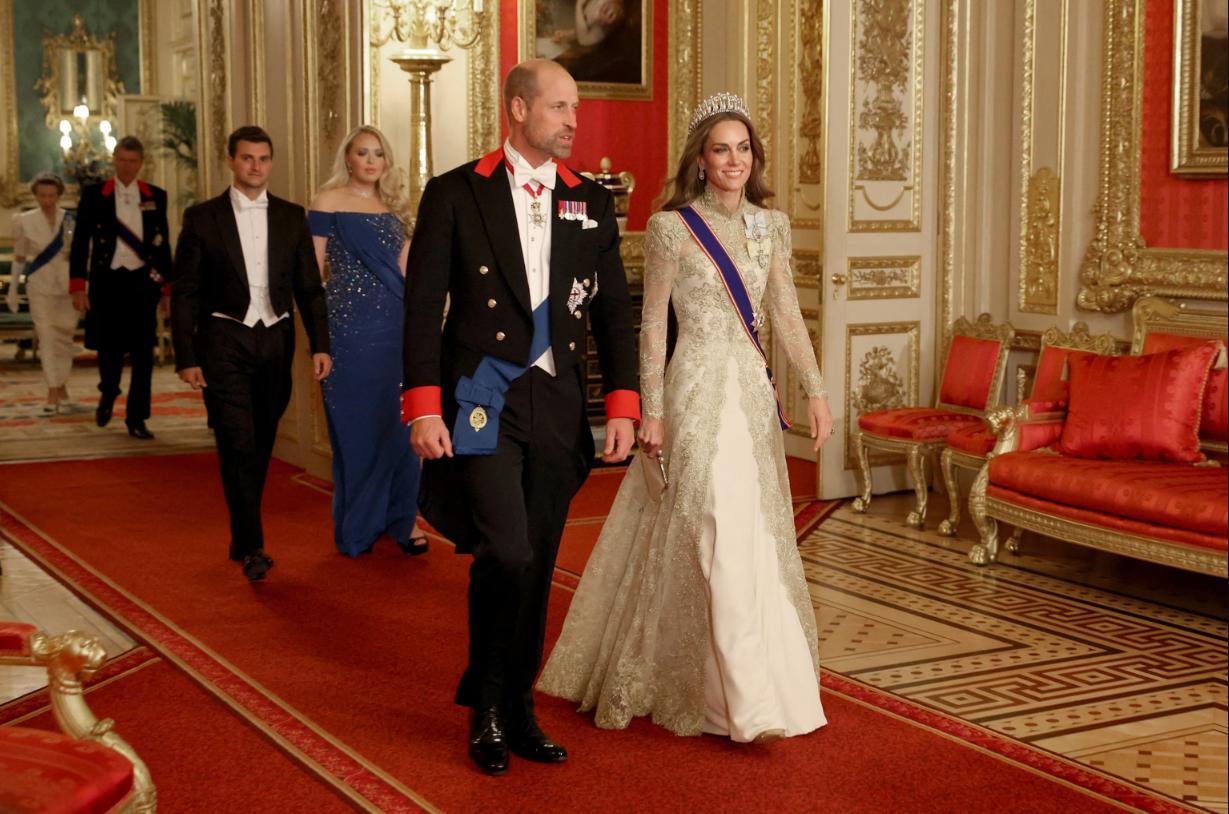
From the moment she entered, Catherine commanded attention. She wore a couture gown by Philip Aleppoli, featuring a silk crepe underdress layered with a full-length hand-embroidered gold Chantilly lace evening coat. The rich golden tones, shimmering under the candlelight of St. George’s Hall, radiated warmth and strength, a visual statement of her renewed presence after stepping away from public life for much of the previous year. The choice of gold carried symbolic weight, evoking majesty, stability, and optimism, while also setting her apart in a room filled with diplomatic finery.
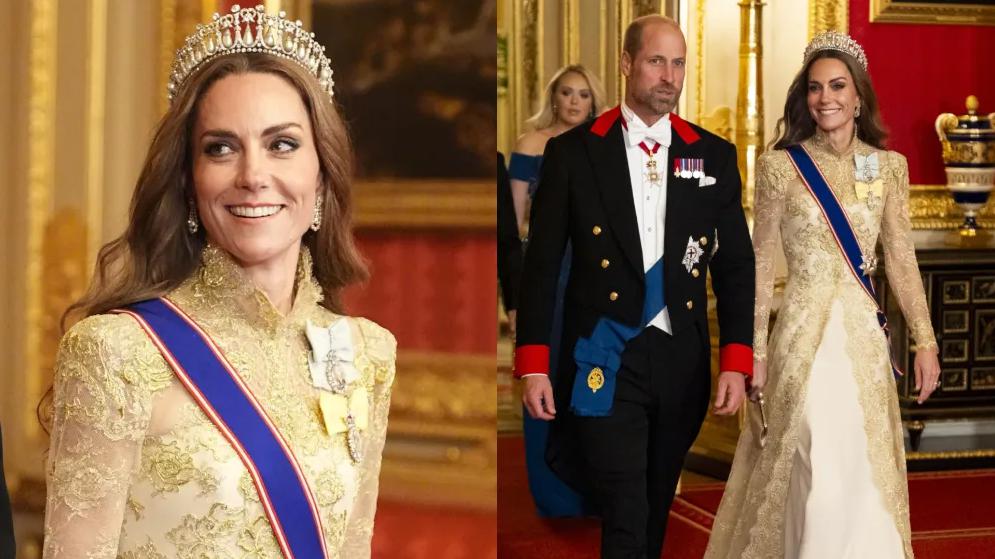
The ensemble was crowned with the Lover’s Knot Tiara, one of the most iconic jewels in the royal vault. Once a favorite of Princess Diana, this tiara—with its diamond arches and dangling pearls—has become synonymous with Catherine herself, a headpiece she has worn for many of her most significant state occasions. The tiara’s history gave the evening an added layer of poignancy: it linked Catherine not only to the legacy of Diana but also to the continuity of royal tradition, while affirming her position as the monarchy’s modern face.
Her accessories carried equally profound meaning. She paired the tiara with drop earrings once belonging to Queen Elizabeth II, an understated yet powerful nod to the late queen whose example still shapes Catherine’s role. Draped across her gown were the Royal Family Orders of King Charles III and Queen Elizabeth II, as well as the sash and star of the Royal Victorian Order, visible emblems of her senior status. Together, these honors placed Catherine firmly within the visual hierarchy of the monarchy, reminding audiences that she is not only a future queen but also a present leader in Britain’s soft diplomacy.



Observers quickly noted the significance of the moment. This was one of Catherine’s first major tiara appearances since announcing her cancer remission earlier in the year. Her return to public duties had already been carefully paced, but the banquet marked her re-emergence on the world stage. Dressed in gold and diamonds, she appeared both radiant and resilient, her look embodying continuity in the monarchy while symbolizing personal triumph. For many, the tiara and jewels were more than decoration—they were a declaration of strength, heritage, and hope.
At her side, Prince William was equally polished, wearing the traditional Windsor uniform: a dark navy jacket with a scarlet collar and cuffs, paired with black trousers and white bow tie. His decorations were a testament to his growing stature: the sash and star of the Order of the Garter, insignia from the Order of the Thistle and the Order of the Bath, and a collection of medals marking Queen Elizabeth II’s Golden, Diamond, and Platinum Jubilees, as well as the Coronation Medal of King Charles III. Together, the Prince and Princess projected an image of unity, elegance, and stability—qualities that define the monarchy’s public face.
The grandeur of St. George’s Hall, stretching nearly 55 meters and adorned with the coats of arms of every knight of the Garter since 1348, amplified the sense of history and pageantry. Beneath its vaulted ceiling, the state banquet unfolded with speeches, toasts, and ceremonial flourishes. President Trump, in his remarks, described William as “remarkable” and praised Catherine as “radiant and beautiful,” comments that reflected the intense global attention fixed on her return. While his words drew a mix of reactions, Catherine’s calm composure ensured the evening remained firmly anchored in diplomacy.
Earlier that day, the Prince and Princess of Wales had joined the King and Queen in formally welcoming the American visitors. For this occasion, Catherine wore a maroon Emilia Wickstead coat dress paired with a Jane Taylor hat and her burgundy Chanel handbag—a familiar piece from her wardrobe that signaled continuity with her past fashion choices. She also wore the emerald and diamond feather brooch once belonging to Princess Diana, linking her appearance to the legacy of the title “Princess of Wales.” The contrast between this tailored daywear and her opulent evening gown highlighted Catherine’s ability to navigate the balance between accessibility and majesty.
The evening concluded with the traditional procession of Scottish pipers, a flourish dating back to Queen Victoria, which echoed through the hall as a reminder of the monarchy’s enduring rituals. For the guests, it was a breathtaking finale; for Catherine, it was a moment of quiet triumph.
Her appearance was more than a fashion success—it was a powerful reassertion of her place at the heart of the royal family. By selecting a British designer, wearing jewels tied to Queen Elizabeth II and Princess Diana, and embracing the ceremonial weight of her honors, she underscored her role as both a custodian of royal tradition and a forward-looking figure of resilience. In shimmering gold, she embodied not only the monarchy’s past but also its future.