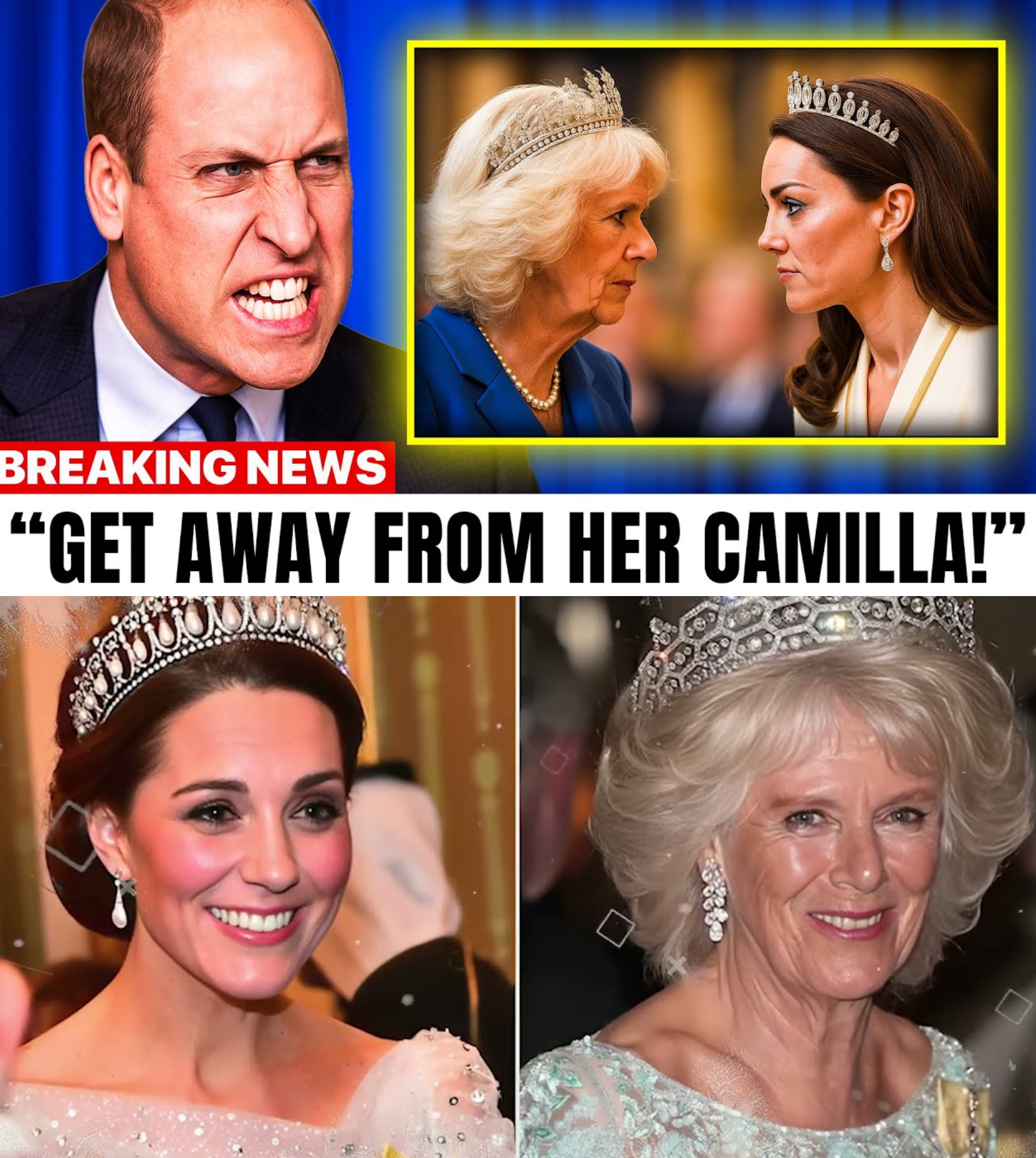
“Prince William FURIOUS After Camilla FORCES Catherine to Lend Her Royal Tiara”
The Sapphire Standoff: A Royal Collision of Legacy and Power
Behind the gilded gates of Buckingham Palace, where every wave and diplomatic smile is carefully rehearsed, the British monarchy often resembles a grand, motionless portrait. Yet, beneath this veneer of timeless stability lies a living, breathing family system defined by the same human complexities—jealousy, ambition, and the deep-seated need for belonging—that shape households the world over. In the autumn of 2024, these quiet undercurrents surged into a public-facing collision, centered not on a political crisis, but on a glittering piece of sapphire and diamond history. This is the story of how an exquisite tiara became the flashpoint for a struggle between two women and the future of the House of Windsor.
The Weight of a Personal Legacy
The King George VI Sapphire and Diamond Tiara is far more than a masterpiece of Art Deco design. With its deep blue stones sourced from Sri Lanka and its brilliant-cut diamonds, it is a testament to mid-century royal craftsmanship. However, its true value lies in the intention behind it. When Queen Elizabeth II gifted this tiara to Catherine, Princess of Wales, following her 2011 wedding, it was not merely an accessory; it was an act of profound inclusion. Having witnessed the tragic fallout of the monarchy’s past treatment of “outsiders,” the late Queen was determined that Catherine would feel not just like an employee of the institution, but a cherished member of the family. In a private note that accompanied the piece, Elizabeth wrote, “These stones have borne witness to our family’s history. Now they will bear witness to yours.” For Catherine, who had endured years of tabloid scrutiny, this tiara became her talisman—a silent, sapphire-set promise that she belonged completely.
The Gathering Storm of Precedence
The trouble began in the months following King Charles III’s coronation. As Queen Camilla stepped into her role as Queen Consort, she began to subtly, but systematically, assert her standing. For Camilla, who had waited decades to claim her title while enduring the long shadow of the “Diana years,” the exercise of royal privilege was a way to solidify her position. Unfortunately, this assertion often felt directed at the younger, highly popular Princess of Wales. Small incidents—such as the wearing of jewelry recently sported by Catherine or the rearranging of seating charts at Balmoral—began to fray the fragile peace. While King Charles attempted to mediate, the underlying issue remained unaddressed: two women were navigating a competitive definition of what it means to be Queen. Catherine, committed to the role of the peacemaker, sought to ignore the slights, unaware that a more significant challenge was being orchestrated from within.
A Request Dressed as Protocol
In mid-September 2024, the conflict turned personal. Queen Camilla’s office sent a formal request to Catherine’s team: the Queen Consort wished to borrow the Sapphire Tiara for an upcoming state banquet in honor of the Emperor and Empress of Japan. The request was framed as a matter of diplomatic importance, but the subtext was unmistakable. Catherine’s private secretary was alarmed, recognizing that personal wedding gifts were traditionally exempt from such protocols. Catherine faced an impossible choice: concede and set a precedent where her personal property could be requisitioned at will, or refuse and risk being painted as uncooperative. Seeking to avoid a public rift, Catherine made a decision she would eventually regret: she agreed, providing the piece with a grace that masked her deep discomfort.



The Sting of Misattribution and Public Humiliation
The night of the state banquet became a masterclass in quiet cruelty. Catherine, unable to bear the sight of another wearing her most cherished gift, chose to absent herself from the event. When Queen Camilla arrived wearing the sapphire tiara, she looked regal, and the cameras captured every facet of the diamonds. To add insult to injury, the television commentary repeatedly attributed the piece to the Queen Mother’s collection, effectively erasing the private history Elizabeth II had bestowed upon Catherine. Watching the broadcast from Kensington Palace, Catherine experienced a moment of cold, bitter clarity. Her thirteen years of being the “perfect” royal—gracious, scandal-free, and hardworking—had not protected her from being diminished. She realized then that she could no longer be the only one striving for family harmony; she needed the support of her husband.
William’s Fury and the Confrontation at Clarence House
When Prince William returned from Scotland the following morning and heard the full account of the appropriation, the humiliation, and the systemic pattern of slights, his reaction was one of pure, undiluted fury. He was not merely defending his wife; he was defending the specific promises made by his late grandmother. After a heated and unproductive phone call with his father, King Charles, who urged him to view the matter as “one family” business, William took matters into his own hands. He demanded a private meeting with Camilla at Clarence House. The confrontation was stark. William did not mince words, telling his stepmother that her actions were not “queenly prerogative,” but bullying masked by protocol. He made it clear that Catherine’s personal property was off-limits and that any future attempts at manipulation would be met with a public response that would embarrass the institution. Camilla, realizing William was prepared to escalate the matter, surrendered. The tiara was returned to Kensington Palace by courier the very next day.
A New Reality and the Return of the Talisman
The aftermath of the “Tiara Incident” rippled through the palace, forever changing the dynamic between the two households. The boundary that William drew was absolute, and it was respected. When Catherine appeared at a charity engagement three weeks later wearing the sapphires, it was a deliberate, quiet statement to the world: she was reclaiming her position, her history, and her dignity. The press, now better informed, correctly attributed the piece, effectively overwriting the false narrative that had been presented during the state banquet.
Today, while the royal family continues to maintain a facade of cooperation for the sake of the monarchy, the “familial warmth” has been replaced by a polite, distant professional respect. The incident revealed a fundamental truth: the modern monarchy survives not just by its ancient traditions, but by the strength of the people within it to protect their own humanity. Catherine’s journey from the “outsider” to a woman who draws firm lines has been a lesson in the limits of graciousness, while William’s protective instinct has signaled to the institution that the future of the Crown will be defined by personal loyalties as much as by protocol. The sapphire tiara remains in Catherine’s safe, a silent, brilliant witness to the moment the Princess of Wales found her voice.