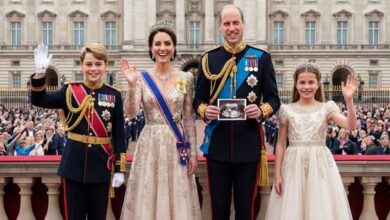
Princess Kate Dazzling In Gold Dress As She Honors Queen Elizabeth at Windsor Castle
The state banquet of September 17th, 2025 at Windsor Castle was more than just a diplomatic engagement—it became a tableau of history, symbolism, and continuity, with Catherine, Princess of Wales, at its very heart. Welcoming U.S. President Donald Trump and First Lady Melania Trump, the evening carried all the splendor of royal tradition: glittering chandeliers, gilded candelabras, and a guest list of dignitaries from across the globe. Yet the most memorable sight was not the grand surroundings, but Catherine herself, whose golden gown drew immediate comparisons to the late Queen Elizabeth II, weaving a delicate thread of remembrance into the fabric of modern diplomacy.
At 43, Catherine’s confidence in her role was unmistakable. The bespoke gown, designed by British couturier Philip Aleppoli, was a triumph of craftsmanship—its full-length silhouette constructed from hand-embroidered gold Chantilly lace, draped elegantly over a silk crepe underlay. As she moved beneath the Castle’s light, the gown shimmered with quiet majesty, commanding attention while exuding refinement. Draped across her shoulders, the embroidered evening coat extended the gown’s drama, while its structured sleeves echoed the stately formality expected of such an occasion.
Her jewelry choices amplified the tribute. The pearl-and-diamond Queen Mary’s Lover’s Knot Tiara—a favorite of Princess Diana—sat proudly atop her dark, swept-back hair, its timeless beauty gleaming beneath the chandeliers. From her ears hung diamond earrings once worn by Queen Elizabeth II, their sparkle reminding observers that while the Queen is gone, her legacy endures in the smallest of details. Pinned to her gown were the Royal Family Orders of both King Charles III and Elizabeth II, ribbons of honor that tied together past and present.
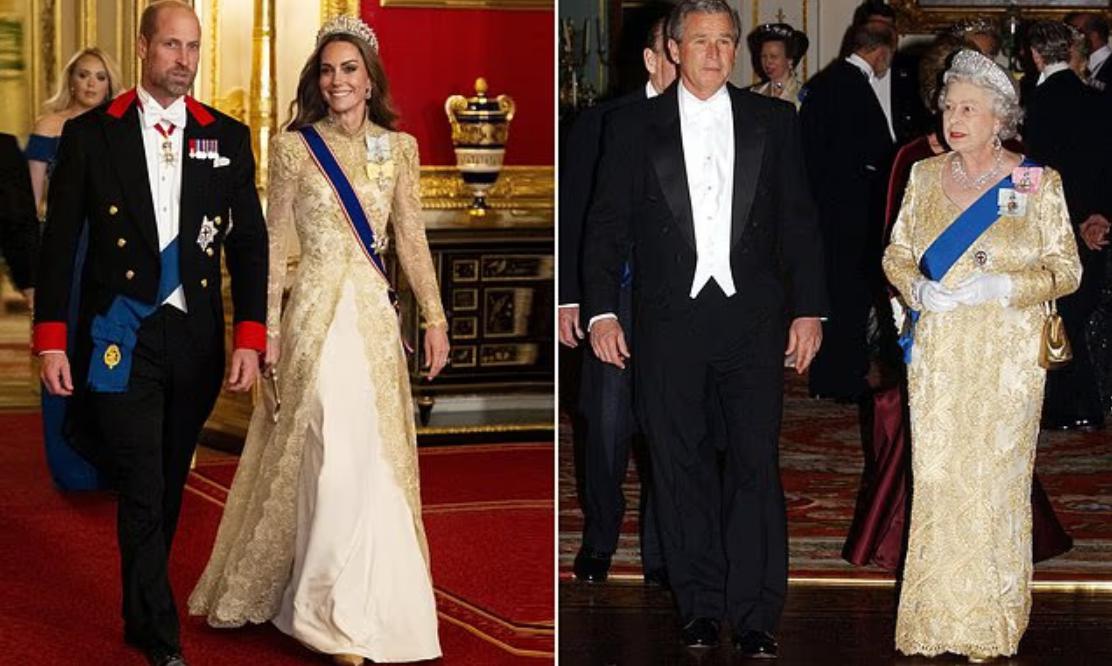
The gown’s golden hue carried its own quiet message. For many, the resemblance to the late Queen’s attire at the November 2003 state banquet for President George W. Bush was unmistakable. On that night at Buckingham Palace, Elizabeth dazzled in a golden lace gown of her own, the rich color chosen deliberately to ensure visibility amid the vast state rooms. Photographs from that evening show her seated beside President Bush, the gold dress shimmering as a beacon of authority and warmth. Two decades later, Catherine’s choice seemed to echo that moment almost deliberately: two royal women, separated by time, but united by diplomacy, heritage, and the shared weight of visibility.




The historical resonance extended further still. Queen Elizabeth’s reign saw her host no fewer than 13 U.S. presidents, beginning with Eisenhower in 1957. Each engagement was carefully choreographed, her attire chosen as a subtle diplomatic gesture—be it a pale blue gown to honor American colors during President Obama’s 2011 visit or a violet ensemble to complement Ronald Reagan’s state dinner in the 1980s. Catherine, stepping into this tradition, demonstrated that she has not only inherited the jewels of the monarchy, but also its language of fashion as soft power.
Earlier in the day, her wardrobe had already spoken volumes. Greeting the Trumps alongside King Charles and Queen Camilla, Catherine wore a burgundy coat dress by Sarah Burton for Alexander McQueen, accessorized with Queen Alexandra’s Three Feathers Brooch. This historic jewel, dating back to 1863, has long symbolized the Princess of Wales title. Once styled by Princess Diana as a necklace pendant, later worn by Camilla, its reappearance on Catherine’s lapel was a reminder of continuity and evolution within the role she now inhabits. Subtle coordination was evident too: Prince William’s tie echoed her burgundy palette, while Charles and Camilla wore shades of blue and white, together forming a sartorial nod to the American flag.
By evening’s end, the press and commentators agreed: Catherine’s golden gown had stolen the show. Beyond the glitter of chandeliers, it was her presence that lingered most vividly—a vision of resilience, grace, and historical memory. For those who remembered Queen Elizabeth’s 2003 banquet, the parallel was powerful. In one golden gown, Catherine paid homage to a woman who defined royal diplomacy for seven decades, while signaling her own ability to carry that mantle forward.
The symbolism was unmistakable. Gold is a color of permanence, strength, and legacy. On that night, in a hall filled with power and pageantry, Catherine shone not just as a consort-in-waiting, but as a custodian of the monarchy’s heritage, bridging eras with a single choice of attire. It was a reminder that in the royal family, fashion is never merely fashion—it is history made visible, diplomacy rendered in silk and lace, and a living echo of those who came before.